Showing posts with label ICC World Cup 2015. Show all posts
Monday, June 12, 2017

Two Key Measures to Identify Pakistani Batsmen Hampering the Team's Cause

Around the time of the World Cup 2015, I did an analysis based on a Facebook discussion I had. The analysis comprised understanding how often top batsmen hit boundaries in ODI cricket and how often do they rotate the strike. The main reason behind this was to determine how Pakistani batsmen fared compared to their international counterparts.

The results back then left a lot to be desired and it showed that Pakistani batsmen were well behind others in terms of boundary hitting, as well as, running between the wickets.

Since that World Cup, Pakistan has changed ODI captains twice. Both captains, Azhar Ali and Sarfraz Ahmed, have talked about changing the way they play ODI cricket. Both captains talked big about adapting to modern day demands, being more aggressive, and improving Pakistan's overall ODI game.

That is all that has been there in the two years and a bit since that World Cup - Talk.

There has been very little action.

I revisited that analysis for the top 50 ODI run scorers since the World Cup 2015. Just to recap, the two measures used to measure the effectiveness of batsmen are Boundary Rate and Rotation Rate.

Boundary Rate tells you how many deliveries a batsman faces on average before hitting  four or a six.

Rotation Rate tells you how often a batsman scores of deliveries that he does not hit for a boundary; i.e. how often a batsman rotates the strike.

Here are the results.


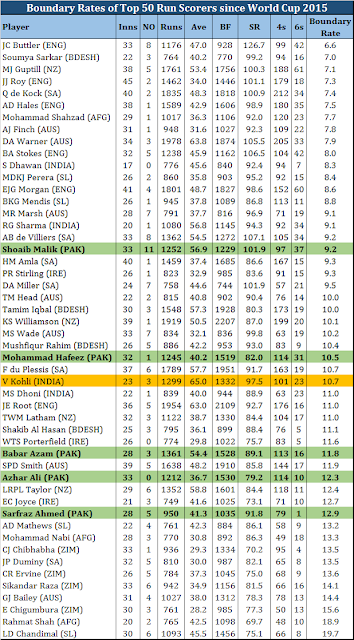
The average number of deliveries for these batsmen to hit a boundary is 10.7.

Only one of the Pakistani batsmen, Shoaib Malik, fares better than this. While Hafeez hits a boundary as per global average, Pakistan's other leading batsmen take a few more deliveries before hitting one.

It is interesting to note that majority of the batsmen that hit a boundary every 7-8 deliveries are openers demonstrating the art of utilizing the fielding limitations in the first 10 overs and taking aggressive starts.

No surprise that none of the Pakistanis feature there.


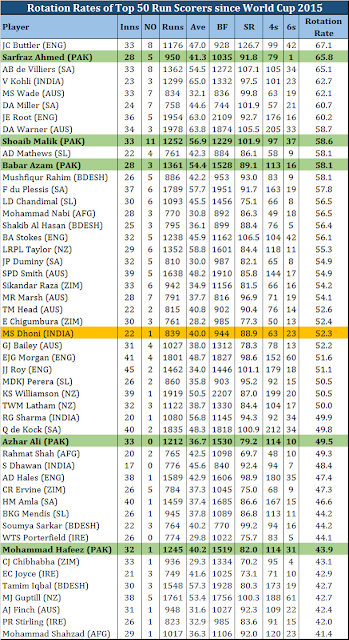
Rotation Rate tell a slightly different story. The global average is 52.3; implying that batsmen take at least a run on 52.3 deliveries out of 100, off the deliveries that they do not hit for a boundary. In other words, batsmen rotate the strike on average every second delivery they face.

Three Pakistani batsmen rotate the strike at a rate better than this - Sarfraz Ahmed, Shoaib Malik, and Babar Azam.

Pakistan's ODI captain in fact has the world's second best rotation rate, strengthening the case for Sarfraz to bat higher up the order. Shoaib Malik should probably also be batting a position higher.

Azhar Ali and Mohammad Hafeez are below par when it comes to rotating the strike. Hafeez, in fact, is outright pathetic as he languishes near the bottom of the table. He has a healthy average and decent strike rate but his inability to rotate strike puts needless pressure on his partners and on the team.

So while the new ODI captains have made the big talk, they have not been able to back it up with action. Pakistan has the ability to play modern day ODI cricket; however they will not be able to till the likes of Mohammad Hafeez and Azhar Ali keep featuring in the top 4 of their ODI batting line up.

Numbers 5 and 6 are too low for Malik and Sarfraz and they need to be at least one position higher. Sarfraz should maybe open in place of Azhar and ideally Haris Sohail should come in for Hafeez.

Pakistan needs to back up its talk with some action in the middle and it can only be done with a change in personnel, because the current one doesn't seem to have the intent to play more aggressively.

Make your pitch on this post...


Labels: , , , , , , , , , , ,


Tuesday, March 31, 2015

ICC World Cup 2015: Our Best XI

The ICC World Cup 2015 is over and it is that time again where everyone comes out with their best XI comprising the top performing players of the World Cup.

Martin Guptill, AB De Villiers, Kumar Sangakkara, Mitchell Starc, Trent Boult are the favourites that have featured in every World Cup Best XI out there. Surely we would have picked them too, but we felt that their were some performers that were better than them.

So here it is. Our Best XI of the ICC World Cup 2015.


1. Big NAS

Matin Guptill and Shikhar Dhawan were undoubtedly the best openers in the World Cup. They collectively scored almost a 1,000 runs and both of them knocked two centuries each. But there was one batsman who did better than both of them. Big NAS tweeted over a 1,000 runs single handedly and more than half of those runs came with a tweet that was easily hit out of the park. He was undoubtedly the most in form batsman throughout the World Cup.

Big NAS will open the batting for our World Cup Best XI.

2. Mauka Mauka Man

The Star Sports #mauka ad campaign was such a huge hit during the World Cup that the man in the ad became the most popular household name during the tournament. While Sarfraz, Sangakkara, Dhawan, Boult, Guptill, and ABD all had two Man of the Match Awards each during this World Cup, the Mauka Mauka Man produced a match winning performance in every single ad that came out during the World Cup. That's about 8-9 man of the match awards alone.

We could not deny him the opportunity to open alongside Big NAS in our World Cup Best XI.

3. Mauka Mauka Spoof Man

For every #mauka ad released by Star Sports there was an equally powerful spoof released by Pakistani fans. While there were various contenders for our number 3 batsman, we put our faith in the one who hit last and who hit hardest with Ponka Ponka. For every opener like Amla, Guptill, Dhawan, Warner, Dilshan there is an equally effective one down batsman in Faf, Williamson, Kohli, Smith, and Sangakkara.

Similarly we believe that the best man to come at one down in our World Cup Best XI is the man behind Ponka Ponka, equally effective as our Mauka Mauka Man.

4. Hashtag #LetsRedo92 Inventor

#LetsRedo trended all over social media in the build up to  and throughout the World Cup. Similarities from the birthplace of Pakistan's captain to the prime minister of the country were used to state that this would be Pakistan's World Cup. Sangakkara hit 4 centuries in this World Cup, while there were 5 other batsmen who hit two each. Overall there were 38 centuries scored in this world cup, which was more centuries than in any other World Cup.

#LetsRedo92 alone came up with more similarities than 38 during this tournament. I reckon the number was double but it was probably close to a 100, challenging Sachin's international record of 100 centuries across formats.

Any batsman that can challenge Sachin Tendulkar's record is worth his weight in gold and hence the inventor of #LetsRedo92 is the one for the all important number 4 position in our batting line up.

5. Drop-In Pitch Doctor

Gone are the days when batting in Australia was a challenge. 300 was regularly scored during the World Cup. 300 was also chased. There were 3 scores of over 400. 38 centuries were scored, which included 2 double centuries. 463 sixes were hit during the tournament. No other World Cup has seen such dominance with the bat.

There was only one man behind all these batting wonders - the Drop-In Pitch Doctor, who ensured batsman friendly pitches and a feast of runs. Anyone who can ensure such a feast with the bat cannot be left out of any batting order and he finds a spot at number 5 in our World Cup Best XI.

6. Selfie Creator

Ahmed Shehzad is popularly known as selfie. In the build up to this World Cup the internet was abuzz with various Shehzad and Afridi selfies. They made selfies such a craze that the ICC decided that every Man of the Match during the course of the tournament will post for a selfie in their Twitter Mirror.


There were 463 sixes hit during the World Cup. Gayle alone hit 25 of those, while ABD hit 21. The number of selfies clicked in this World Cup was more than the sixes hit by Gayle and ABD combined! Such a hard hitter is a must have in our World Cup Best XI and the number 6 spot is his.

7. The Man who cried "That wasn't a No Ball"

Only one decision came in between Bangladesh winning the World Cup and getting knocked out in the Quarterfinals. The No Ball that wasn't! Everyone including the ICC President cried foul and maintained that the No Ball that wasn't is what caused Bangladesh's defeat in the Quarterfinal. We are sure that it wasn't a no ball but the man who cried most and maintained that Bangladesh would have gone on to win the World Cup if wasn't given a no ball stumped more people than Brad Haddin, MS Dhoni, and Luke Ronchi combined.

The man who cried "that wasn't a no ball" will be the wicketkeeper of our Best XI.

8. Anushka Sharma

There were several single handed performances that took teams to victory in games during the World Cup. Wahab Riaz vs Zimbabwe, Trent Boult vs Australia, Tim Southee vs England to name a few. But none of these bowlers manage to bowl anyone over the way Anushka Sharma did. She was so effective that she was considered the main reason Australia qualified for the Final of the World Cup. She made only one appearance in the World Cup and that was enough to shatter the dreams of a billion people around the world.

She will be our team's main strike bowler and due to her ability to hit big blows with the bat she is the best option for number 8.

9. BioMechanics Expert

We can't have a complete XI without a spinner in the team. Daniel Vettori and Imran Tahir were the most successful spinners in the World Cup, while Ashwin also fared well. A slow left armer, a leg spinner, and an off spinner - they don't come in more variety than these three but the one who performed better than all these three was the one who was responsible for taking out varieties from the art of spin bowling. 

The Biomechanics Expert ensured that the likes of Saeed Ajmal, Sunil Narine, and Mohammad Hafeez take no part in this World Cup. He spinned out more batsmen than Vettori, Tahir, and Ashwin combined; hence we had no choice but to include him in our World Cup Best XI as our lone spinner.

10. The Left Arm

Mitchell Starc and Trent Boult were the leading wicket takers in the World Cup. Mitchell Johnson showed in the semi final and final why he is arguably the best fast bowler in the world. Wahab's one spell against Australia resulted in an entire country wanting him to be the next captain of Pakistan. James Faulkner was the man of the match of the World Cup Final. The one thing common among these bowlers is their left arm, which produced magically unplayable deliveries for batsmen. Ask Shane Watson.

We could not pick any single one so we just went for The Left Arm to open the bowling for our World Cup Best XI alongside Anushka Sharma. Anyone who does not succumb to the charm of Ms. Sharma will surely fall prey to the left arm.

11. Hashtag #wontgiveitback Inventor

Defending champions India did not want to give the World Cup back. Their entire campaign was based on #wontgiveitback. TV ads, social media posts, public statements, memes, everything came with #wontgiveitback. It was the Indian equivalent of Pakistan's #LetsRedo92.

While Anushka Sharma and The Left Arm will attack with the new ball, we believe the man behind #wontgiveitback is the best option as third seamer given his ability to rile up the entire world with one hashtag.

Make your pitch on this post...


Labels: , , , , , , , , , ,


Sunday, March 29, 2015

ICC World Cup 2015: At the end it was like 1992 after all! Only for Australia.


There was a time when host nations just could not win the ICC World Cup. That trend was disrupted by India who held aloft the World Cup trophy in Mumbai in 2011, and now Australia have joined them after doing the same at the MCG in 2015. And while doing so, Australia also achieved numerous other remarkable distinctions

It is an unprecedented 5th ICC World Cup win for Australia. They have now won the World Cup in every continent that has hosted one, and probably every continent that will ever host an ICC World Cup.

They have appeared in an ICC World Cup Final in every decade since the inception of the World Cup in the 70s and have won at least 1 World Cup in every decade besides the 70s.

11 World Cups. 7 Finals. 5 Titles. Talk about dominating a sport. There is absolutely no cricketing nation like Australia.

Interestingly however, Australia is the only ICC World Cup Champion that did not win the World Cup in their first ever appearance in a Final. All the other champions - West Indies, India, Pakistan, and Sri Lanka - won the World Cup when they appeared in the Final for the first time.

There was an achievement for Darren Lehmann too, who became the first person to win an ICC World Cup as a player (1999) and as a coach (2015). Given the number of World Cups Australia wins, there might be some more players who will join Lehmann in achieving this feat in the future.

The build up to this World Cup for Pakistan fans was all about repeating the feat of 1992, the last time the World Cup was held in Australia & New Zealand when Imran Khan led Pakistan to an unlikely first ever win.

The hashtag #LetsRedo92 trended all over social media networks and fans went crazy citing similarities between 1992 and 2015.

What they probably forgot was that other teams may also be looking to do the same! i.e. #Redo92 !

Now that the ICC World Cup 2015 is over, one can easily look back and see why in fact it was like 1992 all over again.

1. In 1992, 89,000+ spectators at the MCG for the final broke the world record for attendance on a single day of cricket in Australia. In 2015, 93,000+ spectators at the MCG for the final broke the world record for attendance on a single day of cricket in Australia.

2. In 1992, Pakistan's captain Imran Khan top scored for his team with 72 and led Pakistan to victory in the World Cup Final in his last ever ODI appearance. In 2015, Australia's captain Michael Clarke top scored for his team with 74 and led Australia to victory in the World Cup Final in his last ever ODI appearance.

3. In 1992, Wasim Akram, a left arm paceman, picked up 3 wickets in the Final and was declared Man of the Match. In 2015, James Faulkner, a left arm paceman, picked up 3 wickets in the Final and was declared Man of the Match.

4. In 1992, Javed Miandad was Pakistan's top scorer in the World Cup with 437 runs at an average of 62.42 and he scored a 50 in the Final. In 2015, Steve Smith was Australia's top scorer in the World Cup with 402 runs at an average of 67.00 and he scored a 50 in the Final.

5. In 1992, New Zealand's Martin Crowe was the leading run scorer in the World Cup. In 2015, New Zealand's Martin Guptill was the leading run scorer in the World Cup.

6. In 1992, Wasim Akram, a left arm fast bowler and part of the World Cup winning team, was the leading wicket taker of the World Cup. In 2015, Mitchell Starc, a left arm fast bowler and part of the World Cup winning team, was the leading wicket taker of the World Cup.

7. In 1992, New Zealand dominated the World Cup beating every opposition except the eventual World Cup Champions, Pakistan. In 2015, New Zealand dominated the World Cup beating every opposition except the eventual World Cup Champions, Australia.

8. In 1992, Wasim Akram, Pakistan's left armer, came back for another spell in the middle of the innings and took two wickets in one over to take Pakistan ahead in the Final. In 2015, James Faulkner, Australia's left armer, came back for another spell in the middle of the innings and took two wickets in one over to take Australia ahead in the Final.

9. In 1992, Pakistan's Captain and Vice Captain were involved in a century partnership for the 3rd wicket. In 2015, Australia's Captain and Vice Captain were involved in a century partnership for the 3rd wicket.

10. In 1992, the 3rd highest run scorer of the World Cup was Peter Kirsten of South Africa. In 2015, the 3rd highest run scorer of the World Cup was AB De Villiers of South Africa.

11. In 1992, South Africa lost in the Semi Final to England who lost the Final. In 2015, South Africa lost in the Semi Final to New Zealand who lost in the Final.

12. In 1992, Pakistan reached their first ever World Cup Final after completing an improbable chase in the Semi Final at Eden Park. In 2015, New Zealand reached their first ever World Cup Final after completing an improbable chase in the Semi Final at Eden Park.

I'm sure we can find many more similarities if we keep looking, but it wasn't like 1992 the way we wanted it for Pakistan. It sure was for Australia, who are absolutely the best cricket nation this world has seen.

I don't think any other team has dominated a sport the way Australia has dominated cricket. Brazil comes to mind. They have also played in 7 FIFA World Cup titles, won 5 of them, and won them across 4 continents. However, that has come over 20 tournaments, as compared to 11 for Australia. If anything, Australia has been twice as dominant in cricket than Brazil has in Football. Australia's run also includes three consecutive World Cup wins, something Brazil has not managed.

Talk about dominating a sport. Salute to Australia!

Make your pitch on this post...


Labels: , , , , , , , ,


Wednesday, March 25, 2015

ICC World Cup 2015 Review: A Pakistan Perspective

By Osama Siddiqui
With Pakistan’s World Cup campaign now over courtesy of a QF exit on par with pre-tournament expectations, its time to take a look back at the players’ performance and the future outlook.
Player Stock – Biggest Gainers
Wahab Riaz
Pakistan’s player of the tournament without any question, and that was before The Spell against Australia. From the very first game he was quick, fearsome and had batsmen deep in their crease. All the pre-tournament talk about speed centered around Steyn, Starc and Milne, but Wahab’s 154 kph thunderbolt in Pakistan’s opening game against India remains the tournament’s fastest delivery. Since his comeback against Sri Lanka last year he’s finally consistently stringing together the kind of performances that he’s been hinting at since his Test debut and his semi final performance at the last World Cup. Tellingly there have been no discussions about fixing his wrist position or release points. He’s been entrusted to run in and bowl fast, and he’s repaid the faith. His bowling has now become must watch theater for cricket fans around the globe. The only question right now is how long he can continue on this new found run of pace and consistency. He’ll be 34 by the time the next World Cup comes around, and if he wants to ensure he remains effective into his 30s he needs to work on his yorker and the ball that comes back into the right handers.
Sarfraz Ahmed
Came into the World Cup on the back of a record breaking year in whites in 2014, firmly cementing himself in both the Test team and the hearts of the nation. Recalled to the limited overs setup on the back of his Test form, he performed well as a makeshift opener in the absence of Mohammad Hafeez and was selected for the World Cup as first choice gloveman and backup opener. A couple of poor performances both in front of and behind the stumps in the leadup matches to the World Cup, meant that all of a sudden he found himself both out of the playing XI, and with his ability to open the innings completely and suddenly disregarded by the team management. Injuries and the form of the other openers meant that he did finally get a chance in the World Cup, in a must win match against South Africa no less. 3 matches, 160 runs, and a century later, there is no longer room for any questions. His approach of backing himself to play his natural game, constantly looking to rotate the strike and remain proactive throughout his innings showed that talk of his technique not being suited to the conditions was just that, talk. Just as refreshing as his own batting was the visible effect he had on his partners, even pushing and cajoling Ahmed Shahzad to reach a half century at a run a ball against Ireland. Although doubts about both his glovework and his ability to be a long term solution to the opener problem remain, he has undoubtedly shown that he deserves the extended opportunity to make both roles his own.
Player Stock – Non Movers
Misbah ul Haq
As expected he scored runs, and as expected he was criticized and lauded in equal parts for the manner in which he scored them. Despite having a few opportunities he couldn’t sign off his ODI career with the century that would have brought immense pleasure to him and his fans. As captain he started the tournament in conservative fashion, but starting from the Zimbabwe game with the dropping of Younis Khan, and in his demeanor in the field he showed a new and hitherto unseen attacking streak. With 4 quick bowlers at his disposal he looked for wickets throughout the innings in a manner in which he has not when Pakistan has had 3 and at times even 4 spinners in their ODI attack. There remained the feeling however that this new found approach came a little too late, and only when there was no other option. Ultimately as captain he is judged by the team’s performance, and a 3rd place finish in the Group stages and a Quarter Final exit was on par with pre-tournament expectations.
Mohammad Irfan
Came into the World Cup with his workload and fragile body carefully managed, and expected to lead the attack in Ajmal’s absence, but fitness doubts still lingered. Ultimately the fitness doubts were confirmed as he suffered another stress fracture and took no part in Pakistan’s last 2 games. Despite his limited appearances he left some lasting memories both good and bad. He looked completely out of sorts against India, but bounced back with some incisive and quick spells, especially against Zimbabwe and South Africa. Although there have been no such signs from team sources, one gets the feeling that this latest injury could mark the end of Irfan’s career. If this is the end of the road for him, he will be fondly remembered for his brief spell in international cricket in which he challenged top order batsmen with his unique combination of pace, steeping bounce off a good length and the left armer’s natural angle. Equally he should be remembered for the remarkable improvement he made both as a bowler and a fielder between his international debut in 2010 and his recall in December 2012.
Haris Sohail
His selection came about as a result of being in the right place at the right time. A member of the Test squads against Australia and New Zealand when doubts about Hafeez’s action first surfaced, the management decided to work on his bowling and quickly decided that he had done enough to fill in as 5th bowler in the ODI arena. He replaced Fawad Alam for the ODIs against New Zealand, made a few decent scores and even bowled with decent results. Eventually come the World Cup, his bowling was hardly required and although he performed better than most of his middle order counterparts that’s not saying much. Nothing we’ve seen so far suggests that he’s a misfit in the ODI arena, but tellingly his List A performances have been average where he’s yet to score a century and it’s his First Class record that’s exemplary. A definite long term prospect in whites, the jury’s still out on his long term prospects in colors.
Sohail Khan
Made pre-tournament headlines by calling out Kohl and then backed up his words by being the man to dismiss him. His last over against India was brilliant and he missed out on a hat trick by the narrowest of margins. Looked impressive in parts, but very ordinary in other parts, often moving between the 2 extremes within the same spell, and ended the World Cup as Pakistan’s most expensive front line bowler. He probably hasn’t done enough to cement a regular place in Pakistan’s limited overs squads for the upcoming series. Unfortunately he’s also one of the players who needs to work hard on his fitness and fielding standards.
Rahat Ali
A surprise late call up to the squad as an injury replacement for Junaid Khan, he made the squad more for his work horse performances in the Test team than for his recent List A performances. He repaid the faith with some good performances once he was brought into the playing XI. Tall, strong, the ability to bowl long spells, moves the ball both ways, he has all the tools that a fast bowler requires. He is missing the spark that is necessary to be the leader of the bowling unit, but he can be an excellent second or third seamer for Pakistan for many years to come. He would have been higher on this list if not for his poor fielding standards and That Drop. Even if he had held on to it 213 was probably not going to be enough, but with Wahab in that mood you never know. It will remain the What If? moment of Pakistan’s campaign.
Ehsan Adil
Picked up a wicket in both matches that he played, and although he certainly didn’t look out of his depth at this level, he failed to impress as well. His domestic stats are impressive, and the management it appears thinks highly of him and are likely to give him extended chances to cement a place in the team. If that does indeed happen, he must improve his fielding. The days of tolerating shoddy fielding from a fast bowler are long gone.
Yasir Shah
No less a player than Shane Warne has branded Yasir as his favorite player and the best legspinnner in the world. He only got the one opportunity in this World Cup against India, and was thoroughly unimpressive, he would have perhaps been better suited making his World Cup debut against West Indies in the next match. He’s on as a non mover because that performance can be put down to nerves, and he’ll certainly get extended chances to prove himself in colored clothing as we look to build a new team. Although he is an able fielder he will be remembered for his mistakes in this World Cup. He couldn’t hold on to the potentially game changing tough chance offered up by Kohli off Afridi’s bowling in Pakistan’s opening game, and who can forget the moment when he pantsed himself attempting to stop a boundary in the deep.
Player Stock – Biggest Losers
Nasir Jamshed
There once was a talented left handed Pakistani opener named Nasir Jamshed, now there is just a left handed Pakistani named Nasir Jamshed. He was perhaps unfairly thrust into the team, but as a member of the World Cup probables and ODI squads leading up to the World Cup, the call up shouldn’t have come as a complete surprise. Getting out is excusable, getting out for consecutive single digit scores can even be excused. But what is completely inexcusable is, being dismissed in the exact same manner each time, and setting new lows in international fielding and fitness standards. It is worth investing time and effort in him still, for the chance of rediscovering his early promise and potential. But regardless of how many runs he may score in the future to push for a possible recall, unless he significantly improves his fielding and fitness standards he should not be allowed anywhere near the international setup.
Younis Khan
Came back into the ODI team on the back of a record breaking Test run against Australia and New Zealand, he cemented his place for the World Cup with a scratchy hundred in the last ODI in the UAE just as it looked it he wouldn’t make the flight to Australia. Ultimately he was completely unable to translate his Test form to the ODI arena and seemed to lose the ability to score altogether. His dismissal against India was not befitting a player of his Test stature and record, and although he looked fluent in his brief stay at the crease against South Africa, he will want to forget these last few months. The hope is that the public does too, and does not let the narrative of ‘a selfish plea to play in the World Cup’ overshadow his significant and ongoing contributions to Pakistan Cricket in the Test arena. Despite expressing a desire to play on and even to captain the ODI outfit if the opportunity were to present itself this is almost certainly the end of Younis Khan’s ODI career. Should the selectors discuss their intentions with him in person this time and hopefully not following a family tragedy, I am certain he will take their decision with grace and humility.
Shahid Afridi
The stage was set for a final hurrah, the moment had arrived, the hour had come, but the man was nowhere to be found. With the ball he was expected to enjoy the conditions, but dropped catches off his bowling and an unfamiliar role as sole spinner meant he never settled and only picked up 2 wickets in the tournament. With bat he could only manage a highest score of 28, lacking even the solitary whirlwind innings he has so enthralled us with over the years. Most surprisingly he appeared listless in the field. The spark, the booming voice, the sign that he was always in the game, were all missing. His stellar form with the bat in the lead up to the World Cup had many believing his retirement was premature, but his performances in this World Cup have shown that the timing was right. The great Brian Lara himself said that when he played cricket, he played to entertain, he considered himself an entertainer. You may scoff at Afridi’s numbers, or curse him for his inconsistency and failure to mature as a batsman, but you must admit that in the ODI arena, few have ever entertained quite like Shahid Afridi.
Umar Akmal
Between the last edition of the World Cup and the current one, only MS Dhoni and Angelo Mathews had scored more runs than Umar Akmal at the number 6 spot in ODIs, and only Dhoni had done it a better average. Despite this there was a sense that Umar Akmal needed to prove himself once again. He had always done well at the ICC events and the general expectation was for more of the same, but it was not to be. There were no signature innings but plenty of what are becoming signature brainless moments. He seems to have developed a new habit of hitting a bad ball straight to a waiting fielder. In 6 innings in this World Cup, he got one bad decision, one great delivery and 4 dismissals off poor balls hit straight to fielders after looking fluent and set for a big score. Worryingly, over the last year, in 17 innings he averages less than 20 with just a solitary 50 plus score. He still has all the tools to be a modern great, but the chances of him putting it all together are far less than they were 4 years ago after the conclusion of the last World Cup. Unlike a Sarfraz Ahmed, Umar Akmal does not seem to thrive under pressure, when the chips are down, when there is something to prove. His career is now at a crucial juncture, and where it goes from here will depend firmly on how he goes about using what is between his two ears.
Ahmad Shahzad
227 runs, an average of 32, the numbers belie how poor his performances really were. Scored some easy runs against Ireland and the UAE, the 2 weakest bowling attacks in the World Cup, but did nothing else of note. Worryingly he is continually praised by the management despite his repeated inability to construct innings and his frequent disciplinary issues. It is premature to call this the end of his international career, especially given Pakistan’s historic inability to develop openers, but other options must be explored.
Sohaib Maqsood
Entered the World Cup with a growing reputation as a solid ODI batsman and a potential future captain, he leaves the tournament with his future in the team under a heavy cloud of uncertainty. Displaying a previously unseen streak of irresponsibility, he was often dismissed as the result of a poor shot. Although I believe he is a long term ODI prospect, I would not be surprised at all if he was dropped from the team for Pakistan’s next tour.
Future Outlook
With the retirements of Misbah ul Haq and Shahid Afridi, the likely end of Younis Khan’s ODI career and continued concerns surrounding the batting, the fielding, and the overall approach to ODI cricket, the selectors and think tank have a lot of work to do and a lot of questions to answer. With Pakistan’s next assignment around the corner, we won’t have to wait long to see which way the wind blows.
The Captaincy
There seems to be no right answer for this, there are however a lot of wrong ones. Any of Shoaib Malik, Mohammad Hafeez, Asad Shafiq, Ahmad Shahzad, and Umar Akmal must be avoided. Ideally the captain should be someone with enough cricket still left in them to be able to lead the team for the next 5 to 7 years at a minimum. He should be someone with a clear vision of how to go about the game, someone who can gain the trust of all the players, the coach and the selectors, and someone with the courage to say no when it matters. With no clear candidate, and a team with potentially no players over the age of 30, the selectors must ensure they don’t fall into the trap of the revolving door captaincy of the 90s. As long as they avoid the obvious wrong candidates, the most important thing will be to give the new captain the time, space, and the long term support to suffer through some growing pains.
The Batting
Pakistan’s ODI batting has long been a concern, the time is right to take a fresh look and overhaul its method and approach, if not all the parts. The fear is that Pakistan’s stellar bowling performances in this World Cup will lead to calls to ‘just bat out the 50 overs’, or ‘leave the aggression to the bowling attack’. Must we be reminded that this is the exact approach we have adopted over the last 4 years, with the spin trio of Ajmal, Hafeez and Afridi along with the fast bowlers putting in stellar performances with the ball? It’s an approach that has seen us challenge for none of the ICC ODI silverware in that time period, and an approach that has seen our ODI ranking fall to 7. Part of the solution lies perhaps in changing the kind of wickets that Pakistan plays most of its ODI cricket on in the UAE. In the UAE the ball often keeps low and stays slow, and there is little reward for stroke makers. Although the natural characteristics of the pitch such as grip for spinners, or abrasiveness to encourage reverse swing should remain, the pitches should also be ones where the ball comes onto the bat nicely and stroke-play is rewarded.
Kohli, Amla and AB may indeed be transcendental talents, the likes of which cannot be replicated, but there are many successful batsmen in the ODI circuit these days who are not lauded for their technical brilliance and were even disregarded as ‘T20 batsmen’ earlier in their careers. No one can disregard basic tenets such as footwork, hand eye coordination and shot selection, but they must go hand in hand with an aim to score first, with an aim to keep the scoreboard ticking, and with an aim to transmit rather than absorb pressure. There are plenty of batsmen that deserve a look, names such as Babar Azam, Sami Aslam, Mohammad Rizwan, and once again Fawad Alam. Although there is no doubt that new faces need to come in, the existing crop of batsmen must be given one last extended chance to prove themselves. A year with greater responsibility and specific targets, they must be told to shape up or shape out.
The Allrounder Slot
It is not difficult to take a look at Afridi’s statistics and dismiss his career, easier still perhaps to think that Pakistan will replace him easily. But for all his maddening inconsistency with the bat, his ability with both bat and ball has made finding the right balance in the team selection an easier job whenever he’s played. Case in point, 4 years on since the last world cup and Abdul Razzaq (who admittedly was the superior all rounder) is yet to be replaced. If Pakistan is unable to find a number 7 batsman that can bowl, (or a bowler than can bat at 7) it will likely ensure the return of Mohammad Hafeez, and unfortunately at the top of the order. One look at the recently concluded domestic season, and its apparent that all rounders are a rare commodity in Pakistan these days. Hammad Azam has been around for a while now, but between continually being overlooked by the selectors, injury concerns and stellar performances in the domestic circuit, unfortunately it looks like he won’t be getting a chance. Anwar Ali and Bilawal Bhatti showed some early promise but neither can consistently give you 10 quality overs with the ball or 30 runs with the bat. Zafar Gohar is another young name that comes up, but his batting is still very raw. One thing’s for sure, whoever does come into the team will have some very large shoes to fill. If not in terms of consistent all round performances, than certainly in terms of sheer entertainment value.
The Spinners
This is one area where Pakistan have multiple answers at their disposal. Ajmal for all his services to Pakistan Cricket and his obvious quality, deserves a recall without a doubt. If his action holds up, and his bowling retains its mystery and accuracy, he will be an asset for at least the next couple of years. Yasir Shah will likely get an extended run in Pakistan’s upcoming series, and then there’s Raza Hassan waiting in the wings. Given that Pakistan’s next series is in Bangladesh, I would expect all three of them to make the ODI squad.
The Pacers
Another area where Pakistan have multiple answers at their disposal, answers that weren’t apparent as recently as even 6 months ago. Wahab is finally ready to lead the attack, Rahat is ready to ably support him, and Junaid will certainly slot in once he has regained full fitness. It remains to bee seen whether Irfan can recover from his latest injury, but if this is the end of the road for him, his loss will not be felt as deeply as it may have been a year ago.
Fielding and Fitness
This is an area of huge concern for the Pakistan Team. Their fielding standards remain below par, and in some cases completely unacceptable. Much was made of Pakistan’s push last year towards improving fitness and fielding standards and of Waqar’s reputation as a taskmaster. For a period of time following the training camp last summer, results were visible. Any gains though have been wiped out now. If a fast bowler can’t bowl 6 overs on the trot, and if any player can’t make a diving stop in the field or hold on to a simple chance, he shouldn’t be allowed in the team. If this means that new talent coming up from the domestic circuit need a couple of months work before they make the cut at the national level, so be it. It’s an investment that will pay dividends.
Misbah ul Haq’s Legacy
Without any obvious improvement in the team since he took over, and without mounting a serious challenge for ICC silverware under his stewardship, his legacy as captain remains up for debate. Ultimately it will be decided in his absence, by where the Pakistan team goes from here. If in 2 years the team has moved up the rankings and mounts a serious challenge for the Champions Trophy, Misbah’s detractors will feel vindicated that Misbah was the man standing between the Pakistan team and progress. If however the team continues to slide down the rankings, Misbah’s supporters will feel vindicated that Misbah was the man standing between Pakistan and ignominy. If still, the status quo is maintained, the debate will rage on endlessly.
Pakistan are currently a long way from consistently challenging for ICC silverware. The future however, looks bright as always. The bowling resources look well stocked for the first time in a couple of years, and the batting although troublesome looks set to turn a corner. The onus however is squarely on the batsmen. For Pakistan to win and win consistently, the batsmen must figure out a way to consistently post large scores and put their talent to good use.

Make your pitch on this post...


Labels: , , , , , , , ,


Saturday, March 21, 2015

Wahab Riaz - The Rise of another W from Pakistan

Pakistan's pace bowling legacy rests on the shoulders of the two Ws, who without a doubt, are a class above other pacers that have played the game. With over 1700 collective international wickets, Wasim Akram and Waqar Younis destroyed many a batting line up and to date remain the best fast bowlers to ever play for Pakistan. Arguably, the best in the world too.

Since they left cricket over 10 years ago, Pakistan has produced plenty of fast bowlers who have tried to live up to the legacy of the two Ws. Shoaib Akhtar, Mohammad Asif, and Mohammad Aamer all showed glimpses of potential that could have taken them to the same heights, but their flaws had the better of them. Aamer may still have the chance, bur the former two will always be a what if for Pakistan cricket.

However, this World Cup gave Pakistan a hero. A very unlikely bowling hero in another W - Wahab Riaz!

Not only was Wahab Pakistan's leading wicket taker in the World Cup 2015, but against Australia he produced one of the most lethal fast bowling spells seen in the tournament, and arguably ever in ODIs. His first two overs produced wickets of David Warner and Michael Clarke, and his next 4 overs were purely hostile.

Wahab's contest with Shane Watson is being talked about all over the world and it will forever be remembered as the best contest within a World Cup game. If were not for a dropped sitter at fine leg, Wahab may have won the match for Pakistan, and he may have taken them all the way.

Wahab has had a chequered career. His 5 for in Mohali 4 years ago was a high point in his career, but in the four years since, he produced little for Pakistan, mostly failing to live up to the hype around him. He remained in and out of the Pakistan side, and largely remained a fast bowler who was easily hit around.

In this World Cup however, Wahab picked himself up and raised his game to another level. He beat Zimbabwe single handedly and gave Pakistan a classic old fashion victory against South Africa. Both those performances came in must win pressure games for Pakistan.

And then there was the spell against Australia.

Wahab's career figures don't say much. An average of over 30 and a strike rate of over 32 are hardly pleasing. But his World Cup figures are legendary,


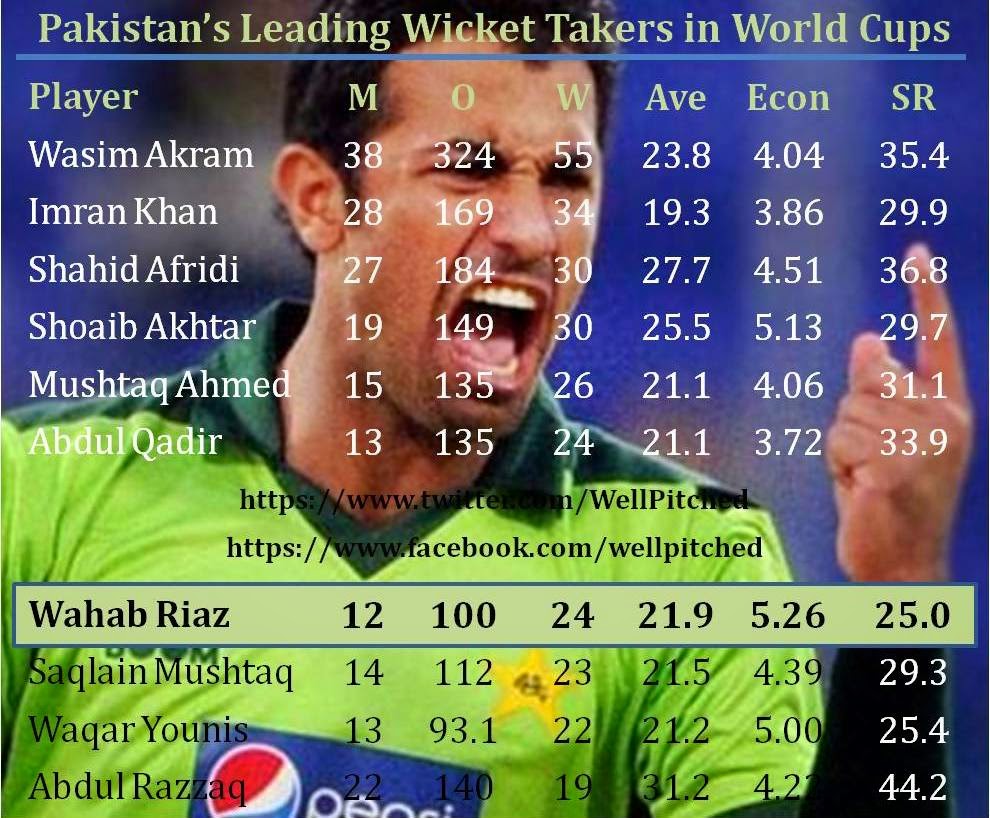
He is already the 4th highest wicket taker for Pakistan among pacers in World Cup matches. Only Wasim Akram, Imran Khan, and Shoaib Akhtar have more wickets than him. And he has played far lesser matches than the them.

Wahab's average among Pakistan's pacers in World Cup matches is bettered by only Waqar Younis (slightly) and Imran Khan. He averages better than Wasim Akram, better than Shoaib Akhtar.

And his Strike Rate is unmatched. A wicket every 25 deliveries puts Wahab head and shoulders above all other Pakistan bowlers in World Cups.

In this World Cup, Wahab Riaz played with passion and aggression, and it was heartening for everyone to see a Pakistan pace bowler give his heart and soul to the team's cause.

Pakistan may have lost the World Cup, but they have undoubtedly found a World Champion.

Make your pitch on this post...


Labels: , , , , , , ,


Tuesday, March 17, 2015

ICC World Cup 2015: Quarterfinalists Hashtags


Make your pitch on this post...


Labels: , ,


ICC World Cup 2015: 15 interesting facts about the 8 Quarterfinalists #15for2015

While the Quarterfinal between South Africa and Sri Lanka will be a battle between the batsmen, the Quarterfinal between Australia and Pakistan will be a battle between the pace attacks. India will be taking on first time ever Quarterfinalists, Bangladesh, while favourites New Zealand are anxiously awaiting the unpredictable yet potentially explosive West Indies.

As we come to the business end of the World Cup, here is a look at some interesting facts about the teams and players that will be taking on each other in a bid to proceed to the semi finals.

1. Sri Lanka have won both their Quarterfinals. Both times they beat England, in 1996 and in 2011.

2. South Africa have never won a knock out game in a World Cup. They have lost both of their Quarterfinals. In 1996 they were ousted by the West Indies, and in 2011 they were ousted by New Zealand.

3. Sri Lanka's batsmen have cracked 8 centuries in this World Cup, while South Africa's have cracked 5. Their collective 13 centuries are more than a third of the total centuries knocked in this World Cup.

4. Sri Lanka' and South Africa's combined 13 centuries are 1 less than the combined centuries scored by the batsmen from the other 6 Quarterfinalists.

5. Both South Africa and Sri Lanka have scored over 300 four times during this World Cup.

6. This is the first time Bangladesh have qualified for the knock out stage in a World Cup.

7. India is one of the only two teams that have won both their Quarterfinals. In 1996 they beat Pakistan and in 2011 they beat Australia.

8. Both India and Bangladesh have in their ranks a batsman who has scored two centuries in this World Cup.

9. Pakistan and Australia, both have a 1-1 record in Quarterfinals. Pakistan lost theirs in 1996, while Australia lost theirs in 2011. Interestingly, both teams lost to India.

10. Australia's pacers have picked up 42 wickets collectively in this World Cup, while Pakistan's has picked up 41. These 83 wickets are 30% of the total wickets picked up by pacers from the other 6 quarterfinalists.

11. Both Australia and Pakistan have relied on 3 left arm quicks each.

12. Pakistan has successfully defended two of the lowest totals in this World Cup - 231 vs South Africa and 235 vs Zimbabwe. While Australia almost defended 151 against New Zealand; they lost by just 1 wicket.

13. Pakistan and Australia have coaches who were part of their World Cup campaigns in 1999 when the two sides met in the final. Darren Lehmann hit the winning runs, while Waqar Younis looked on from the sidelines.

14. New Zealand and West Indies also have a 1-1 record in Quarterfinals. New Zealand lost theirs in 1996, and West Indies lost theirs in 2011. Interestingly it was Australia and Pakistan that beat them in those Quarterfinals respectively.

15. Chris Gayle has smashed the highest score in this World Cup - 215. While Tim Southee has picked up the best match haul in this World Cup - 7-33.  

Make your pitch on this post...


Labels: , , , , , , ,


Monday, March 16, 2015

What a Champion Sarfraz Ahmed is!

I have never witnessed a team management be so wrong about a player. From Waqar Younis to Misbah Ul Haq, absolutely no one had confidence in Sarfraz' ability to open the innings in Australia and New Zealand.

One can't entirely blame them considering that Sarfraz failed in 5 innings in ODIs and practice games in New Zealand and Australia leading up to the World Cup. But once Hafeez was injured and he was the standby opener, I believe he should have played ahead of Nasir Jamshed. However, the team management thought otherwise.

So much so that they gave public statements about how they don't think Sarfraz is technically equipped to open on these pitches. Waqar even went on to say that Sarfraz' career will be destroyed if they opened with him.

Nasir Jamshed failed so miserably that the coach and captain were left with no choice but to bring in Sarfraz for the all important game against South Africa. It was not something Waqar and Misbah wanted. It was something they were forced to do.

The way Sarfraz responded was purely magical. His performances have been a response that I have not seen from anyone who has been so publicly criticized by his own management.

Two matches and he is everyone's hero!

He has played only two of Pakistan's six matches in this World Cup and this is what he has already achieved:

1. The only wicketkeeper from Pakistan to score a World Cup 100.

2. Pakistan's only centurion in this World Cup.

3. Pakistan's first centurion in a World Cup since Imran Nazir in 2007.

4. Two matches, two man of the match awards.

5. Two matches and no bowler has been able to dismiss him.

6. Second most man of the match awards in a World Cup after Kumar Sangakkara.

7. Part of Pakistan's only opening partnership of over 100 in Australia this century. Sarfraz and Shehzad's 120 runs stand against Ireland was Pakistan's only third century opening partnership in ODIs played in Australia and the first in 25 years since Rameez Raja and Saeed Anwar's 202 run stand against Sri Lanka in Adelaide in 1990.

8. Equalled the world record of 6 dismissals by a wicketkeeper in an ODI.

All this and he has played only two matches in this World Cup.

Imagine what could have been had he been playing from the start.

Sarfraz Ahmed is a champion cricketer and he is the best thing that has happened for Pakistan in this World Cup!

Make your pitch on this post...


Labels: , , ,


Tuesday, March 10, 2015

ICC World Cup 2015: Pakistan's Pacers Turn it on!

This article first appeared on DAWN.

Pakistan entered this World Cup having lost an entire bowling attack. Junaid Khan, Umar Gul, Saeed Ajmal, and Mohammad Hafeez were all ruled out before Pakistan even stepped on the field. A bowling attack that had relied on spin for the past 4 years looked entirely transformed as rookies in the form of Sohail Khan, Ehsan Adil, and Rahat Ali joined the relatively experienced Mohammad Irfan and Wahab Riaz in pace-heavy attack. Going into this World Cup, this lot of Pakistani pacers was the most inexperienced pace attack among all test playing nations.


The first two games of this World Cup further highlighted Pakistan's problems with the inexperienced pacers as India and West Indies both posted totals in excess of 300. Within a week of the tournament, Pakistan found themselves in an all familiar situation of having to win every game from thereon to qualify to the next round.

The first of their must-win games was against Zimbabwe. The batting, which still remains sketchy, posted only 235 against a team that had scored over 270 in each of their previous three matches. A top bowling effort was required to defend the sub-par total, and Pakistan's pacers turn it on and how! 4 wickets apiece for Irfan and Wahab and Pakistan romped to victory by 20 runs in a classic old fashioned come-from-behind win scripted by Pakistan's fast bowlers.

Pakistan's batsmen took the game away from a weak UAE side and Pakistan had 2 important wins under its belt going into the all important game against South Africa.

Once again, Pakistan's batsmen disappointed despite an aggressive start by Sarfraz Ahmed and a typical Misbah innings. With only 222 on the board, South Africa were given a DL revised target of 232 in 47 overs. For a team that had posted 400 plus totals in each of its previous two matches, 232 would have seemed like a walk in the park. It should have been like a walk in the park for AB De Villiers and his batting army.

It even looked like a walk in the park as Hashim Amla and Faf Du Plessis dismissed everything bowled at them to the boundary. At one stage, Amla was batting on 28 and all his runs had come in boundaries! 67-1 after 9 overs and once again it looked like curtains for Pakistan. However, what followed was pure magic. In the span of 38 deliveries, which went for 10 runs, Rahat Ali and Wahab Riaz removed Faf Du Plessis, Amla, Rossouw, and Miller. Wahab's first 2 overs yielded no runs and 2 wickets. And Pakistan was back! AB De Villiers put on a lone fight as wickets continued to tumble around him.

Irfan, who had given Pakistan a breakthrough with the second delivery of South Africa's innings, Wahab Riaz, who has lifted his game up multiple levels, and Rahat Ali, who is improving with every game, combined to take 3 South African scalps each. While Sohail Khan, who had picked up a 5-fer in his first World Cup match (against India), captured the prized wicket of AB De Villiers who threatened, albeit briefly, to take the game away single handedly.

Once again, not many expected Pakistan's bowlers to run through South Africa's mighty batting line up the way they did. But for the second time in one week Pakistan's pacers produced performances that Pakistani fans had become accustomed to in the 90s era of Wasim and Waqar. In the excitement of the win, not many realized that Pakistan bowled South African out in a mere matter of 33 overs! That included a batting line up of 5 centurions in this World Cup alone.

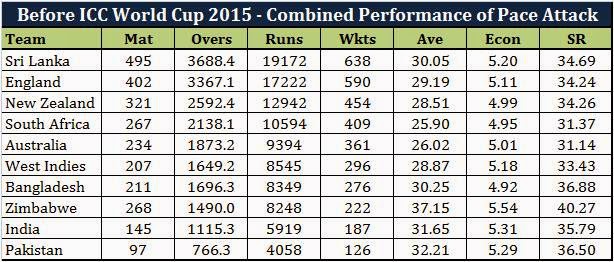
The most inexperienced pace attack in this World Cup now stands as the pace attack with the second most number of wickets in this World Cup.


* Does not include today's England vs Bangladesh match

The average, economy, and strike rate are also impressive, even though they are not right up there with the likes of New Zealand, Australia, and India. The stark improvement in performance of Pakistan's pacers can be seen by comparing their collective figures from before the World Cup to their collective figures during the World Cup.

From conceding 300 plus totals twice in the first week of the tournament to defending totals of under 240, twice in one week, is one grand achievement by Irfan, Wahab, Sohail, and Rahat. One that Waqar Younis and Misbah must be proud of. One that the fans must be over the moon about.

For perspective, Pakistan's 235 against Zimbabwe and 231 (DL adjusted) against South Africa are the two lowest totals that a team has defended in this World Cup. The only other score below 300 that has been defended successfully in this World Cup is Bangladesh's 267 against Afghanistan.

Make your pitch on this post...


Labels: , , , , , , ,


Tuesday, March 3, 2015

ICC World Cup 2015: What is the 'Par Score'?

This article first appeared on DAWN.
When Pakistan completed its innings against Zimbabwe on Sunday, the popular opinion was that 235 was not enough. Social media was abuzz with predictions of Zimbabwe's triumph and how many overs they would take to complete the task.
However, what transpired was expected by very few. It was a tremendous effort by Pakistan's bowlers, despite sloppy their fielding, to overcome the odds and defend a sub-par total against a team which had scores of 277, 286 and 289 which chasing against South Africa, UAE and the West Indies, respectively.
But was 235 really a sub-par total? Everyone from commentators to TV experts and fans have been stating that the par total in this World Cup is 300. I don't think that is true. I think 300 is a winning total, not a par one; more often than not teams scoring 300 will defend it successfully.
I did some digging to figure out whether this hypothesis is true or not, and the results are quite interesting. The analysis considers ODIs played in Australia and New Zealand in past 5 years, starting from 1st January 2010, and breaks down the results for day matches and day/night matches.
ODI Matches in Australia
In all ODI games played in Australia in the past five years, the team batting first has won 37 times, while the team fielding first has won 33 times.
Out of those 37 wins, a team scored 300 or more 14 times and won the match. There are only four instances of a team successfully chasing 300 or more, with the most recent one being Australia's chase of 304 against England in January 2010. Australia has managed three out of those four successful chases of above 300, with the other one managed by India against Sri Lanka in February 2012.
Those four chases came in Hobart, Sydney, and Brisbane. A total of 300 or more has never been chased in Melbourne, Perth, Adelaide, or Canberra in the past five years. Every time a team has scored 300 in any of those grounds, they have won.
Out of those 37 wins by teams batting first, a total between 200 and 300 was defended successfully as many as 23 times; that is a success rate of over 60 per cent. Additionally, almost 60 per cent of the wins by teams chasing targets (19 out of 33), was when the target was below 270.
It is interesting to note that all of the four successful run chases of 300 or more were in day/night games. A total of 300 or more has never been chased in a day game in Australia in the past five years. In fact the highest successful run chase in a day game in Australia is 262.
Therefore, I do not think that 300 is a par score in Australia. It is a winning score. A par score is more around 260 to 270. A total of 270 or more has been defended successfully 22 times, and chased successfully 10 times.


ODI Matches in New Zealand
In New Zealand, the numbers tell a different story. In all ODIs since January 1, 2010, teams batting first have won 26 matches, while the team fielding first have won 31 matches. In day games, the results are more even with 14 wins for teams batting first and 13 wins for teams fielding first. However, in day/night matches, it is interesting to note that teams fielding first have won more games (18) than teams batting first (12).
In every single one of the 26 matches that the teams won while batting first, they posted a total of above 240. In all but two matches, the total was above 265, while in 14 matches a team scored 300 or more and won. That is a success rate of more than 50 per cent for teams scoring 300 or more.
A total of 300 or more has been chased successfully only twice in New Zealand in the past five years, with both instances witnessed during this World Cup - Ireland's win against West Indies and Sri Lanka's win against England. In fact, the three highest successful run chases in New Zealand in the past five years have taken place during this World Cup - the above mentioned matches and Zimbabwe's win against the UAE. Two of those successful run chases took place in Nelson, while one was in Wellington. Such totals have not been chased successfully in Dunedin, Auckland, or Christchurch.
It is also imperative to point out that these three run chases of 310, 305, and 286 by Sri Lanka, Ireland, and Zimbabwe respectively came in day games. Of the 13 successful run chases in day games in New Zealand, only six have been of scores of 240 or more.
Out of the 18 successful run chases in day/night matches in New Zealand, nine were of targets in excess of 240, but all were well below 300. A total of 300 or more has never been chased in New Zealand in a day/night match in the past five years. The highest-ever successful run chase in a day/night match in New Zealand is 276, which was also the highest successful run chase in New Zealand prior to this World Cup, achieved by the Kiwis against Australia in March 2010.
A total of above 240 has been chased successfully only 15 times in New Zealand with nine of them of scores between 240 and 270. A score of 240 and above has been defended successfully as many as 26 times. That is a significant difference; teams batting first and scoring 240 or more win 63 per cent of the matches in New Zealand.
240 is definitely a good score in New Zealand, while 270 can be considered a par one. 300 is undoubtedly a winning total in New Zealand, especially in day/night games.
Significance for Pakistan
Coming back to Pakistan, taking note of these numbers is important for their next two matches against the UAE and South Africa. Both the matches will be played in New Zealand and both will be day/night games.
One must remember that the highest successful run chase in a day/night game in New Zealand in the past five years is 276. The par score in a day/night game in New Zealand is around 270. If Pakistan can bat first and post a total in the range of 260 to 280, its chances of winning will be very high. Even if they are up against AB De Villiers. If Pakistan end up bowling first against South Africa then they need to somehow restrict the Proteas to below 240, otherwise their chances will diminish.

Make your pitch on this post...


Labels: , , , , ,


Saturday, February 28, 2015

Absolute CARNAGE at Eden Park!

Everyone was waiting for the Australia vs New Zealand match with bated breath. The two host nations and the two favourites to win the World Cup were expected to put on a breathtaking show.

Scores above 300 have become the norm in this World Cup. With the firepower in the Australian and New Zealand batting line ups, coupled with the extremely small boundaries of Eden Park, 300 was expected to be easily reached. Moreover, finally there was a game where people expected the side chasing the total to give a fight unlike the way it has been in previous games.

But, what happened out there was not what anyone expected.

The way Finch and Warner started the attack on New Zealand's opening bowlers, it seemed like 400 was on the cards! Warner and Watson continued in the same manner once Finch departed to a brute of a delivery from Southee.

But then a key move by Brendon McCullum, who is fast becoming the best captain in the game, in the 5th over of the innings, changed everything.

With Australia cruising at 51-1 after 6 overs, McCullum handed the ball to his most experienced campaigner, Daniel Vettori.

It was a huge gamble to give a spinner a go inside the powerplay.

Vettori, however, like the champion he is, delivered beautifully and put the brakes on and then finally removed Watson in the 13th over, and then Smith in the 17th over. In the middle, Southee removed Warner as well.

From 80-1, Australia has slid down to 96-4 after 17 overs. Some damage had been done, but it was still a decent platform with Clarke and Maxwell at the crease and Marsh and Haddin to follow.

But what followed was absolute carnage!

Boult, after an opening spell of 0-24 in 5 overs, returned for his second spell in the 18th over and in the span of 18 deliveries removed Maxwell, Marsh, Clarke, Johnson, and Starc to leave Australia reeling at 106-9!

18 deliveries. 5 wickets. 1 run.

No one could have seen that coming. I wonder what the betters went through. Betbind.com are a site where you to keep track of your betting history. For anyone who bets often, record-keeping is imperative. Without accurate tracking of wins and losses, it is impossible to understand what works and what doesn’t. 

That was the most devastating spell of fast bowling this World Cup has seen. Even better than Tim Southee's demolition of England.

Forget 300, Australia were struggling to go far beyond a 100.

Australia's last wicket pair of Haddin and Cummins tried their best to repair the damage and managed to take Australia to 151.

The Aussies, the best batting line up of the tournament, one of the favourites to win, had been bowled out inside 33 overs!

New Zealand's chase was expected to be a cakewalk but it was anything but that!

Their innings began much like Australia's, with Guptill smashing 10 runs of the first delivery thanks to a Mitchell Johnson no ball.

The kiwis were off to a flier, and despite losing Guptill early, McCullum kept going the way he knows best smashing Johnson to all parts of the ground! In 4 overs, Johnson has been carted away for 52 runs!

McCullum reached his 50 off only 21 deliveries, but then departed soon after with New Zealand at an absolutely smashing 79-2 in 8 overs.

Starc began the 9th over and removed Ross Tayor and Grant Elliot of the first two deliveries, either side of the break, in what would be the first of two times that he would be on a hatrick in the match.

New Zealand were 79-4 when Anderson joined Williamson in the middle, and both went about their task quite easily, before Maxwell struck to remover Anderson in the 20th over. New Zealand were 131-5 and needed only 21 runs to win, which should have been like a walk in the park.

But then Starc returned to cause havoc once more.

In the space of 5 deliveries, Starc removed Ronchi, Milne, and Southee. Cummins added the scalp of Vettori, and New Zealand found themselves 9 down with 6 runs still needed for victory.

New Zealand's number 11 survived two deliveries, and off the first ball of the next over, Williamson finished the game with a six!

In what was supposed to be a high scoring thriller, the match turned out to be one entertaining roller coaster ride.

The match barely lasted a total of 56 overs, but it was one of the craziest games of cricket I have ever seen.

Never have a I seen the battle of dominance between bat and ball to such an extent as I witnessed in this game.

When the bat dominated, the ball disappeared to all parts of the crowd at Eden Park. When the ball dominated, the stumps lay shattered!

There were 26 boundaries and 11 sixes in the entire match; meaning that 170 off the 303 runs that both teams scored collectively came through fours and sixes.

There were as many as 8 batsmen who got bowled in the match.

If there was ever a match that defined the word CARNAGE, this was it.

What a game!

Make your pitch on this post...


Labels: , , ,


ICC World Cup 2015: Pakistan must recognize they are the better side against Zimbabwe & Associates

This article first appeared on DAWN.

After a break of over a week, Pakistan will take the field once again in this World Cup on Sunday, which will be the start of a crucial week for Misbah-ul-Haq's side, one that will decide its fate.

In a period of seven days from March 1 to March 7, Pakistan will play against Zimbabwe, UAE, and South Africa. After two big losses, Pakistan could not have asked for a better schedule. The matches against Zimbabwe and UAE are ideal for Pakistan to find some form and rhythm and finally open their account.
However it will be no easy ride given the way Zimbabwe and UAE have so far performed in the World Cup. The coaches of both the sides, Dav Whatmore and Aaqib Javed respectively, are well versed with the strengths and weaknesses of Pakistan; therefore, one can expect Zimbabwe and UAE to be more prepared for Pakistan than they have been for other teams.
Pakistan will also have to contend with Ireland on March 15, in their last group game. The first round exit at the 2007 World Cup, courtesy the Irish, will play on Misbah's mind for sure.
Pakistan's players and fans, though, need to also take inspiration from the past. Their record against the likes of Bangladesh, Zimbabwe, and associate nations in World Cup matches has been largely horror-free. Since 1996, Pakistan have played 12 matches against these countries and have lost only twice.
The key to Pakistan's success against Bangladesh, Zimbabwe, and the associates has been their bowlers' dominance.
While Pakistan have typically batted well in these matches, always posting a total in excess of 250 (except for two instances), it has always been their bowling that has enabled them to dominate the relatively weaker teams in World Cups.
Here are some interesting statistics for these matches, barring the two games that Pakistan lost to Bangladesh in 1999 and Ireland in 2007.
167 The highest score by an associate nation in a World Cup match against Pakistan.

130 The average score for associate nations in World Cup matches against Pakistan.

151 The highest score by Zimbabwe in a World Cup match against Pakistan.

130 The average score for Zimbabwe in World Cup matches against Pakistan.

3 The number of wins Pakistan has against Zimbabwe in as many completed matches in World Cups.

There is no doubt that bowling is going to be the key for Pakistan in their upcoming matches against Zimbabwe, UAE, and Ireland. The attack has conceded over 300 runs in both their World Cup matches and they will have to improve significantly starting this Sunday. We have already discussed how this is Pakistan's most inexperienced pace attack ever in a World Cup, but Mohammad Irfan, Sohail Khan, and Wahab Riaz have looked good in bursts. They will just need to sustain their performance over the duration of 50 overs.
Shahid Afridi, who was supposed to be Pakistan's strike bowler, has struggled and he will definitely need to pick himself up and be the potent force with the ball that he has been in the past. In hindsight, it was a mistake leaving Yasir Shah out against the West Indies, considering the damage Imran Tahir caused against them. He must play in Pakistan's remaining games as he can undoubtedly be the key with the ball against teams who will most certainly struggle against quality leg spin bowling.
Pakistan have dominated Zimbabwe and associate nations in World Cups thus far, and there is no reason why they can't repeat the dose.
The players can get on to the field on Sunday with some degree of confidence knowing that the Zimbabweans have never beaten them in a World Cup match. They should look to seek momentum with good wins over Zimbabwe and the UAE, which they can then take into the all important encounter against South Africa.

Make your pitch on this post...


Labels: , , , ,